Table of Contents
Olympus OM-D E-M5 II
see also:
- dpreview.com's best ILC camera of 2015
ESCAPE = JOY - KAUASxOLYMPUS - an awesome video shot entirely with the E-M5 II hand held in feezing temperatures from KΛUΛS on Vimeo.

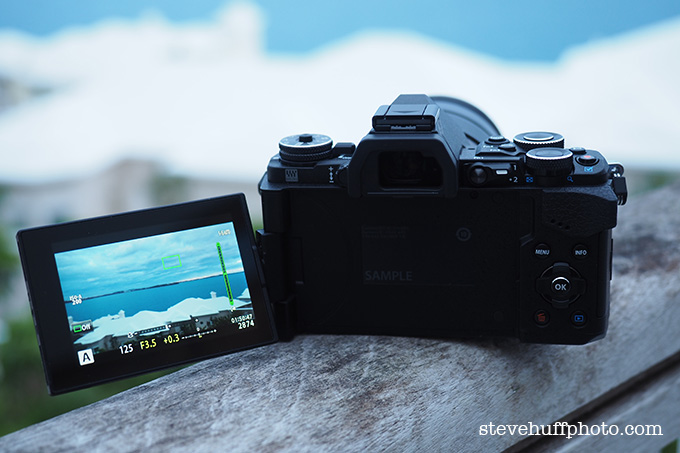
Showing the articulating touch screen LCD - image courtesy of Steve Huff
introduction
- announced Feb 2015
- The Olympus OM-D E-M5 camera was a ground breaking camera that changed everything in 2012, finally bringing together everything that photographers needed into one camera (except PDAF for autofocus for action shots)
- this new 2015 version of this camera builds upon this foundation and extends it in many ways, adding much of the new technology of the pro level camera, the Olympus OM-D E-M1 (but not its sensor, PDAF capability or front buttons), and adds more again such as:
- ground breaking 64mp RAW/ 40mp JPEG HiRes sensor shift mode
- requires tripod, pro lens and static scene ⇒ great for product photography and perhaps THE BEST current camera for photographing art works such as paintings, giving images at least as good as a 2013 Leaf medium format back 1)
- better color detail and much less moire artefacts than a Nikon D810 dSLR
- much improved video along with an articulating, swivel, touch screen LCD screen, much better video codec and and the best image stabilisation of any camera on the market making it one of the best video cameras for hand held work
- silent electronic shutter mode
- 1/16,000th sec electronic shutter option
- even faster S-AF and faster burst rate
- this camera could well end up being 2015 camera of the year just as it's predecessors were
specs
- it is essentially a substantial upgrade to the 2012 model - the Olympus OM-D E-M5 camera, with the same sensor but with changes as follows:
- ON/OFF switch, buttons and dials rearranged to be more consistent with the Olympus OM-D E-M1
- tilt LCD screen changed to a flip out rotating screen
- 63.7mp RAW (9216×6912), 40mp jpeg sensor (7296×5472) shift mode
- by shifting the sensor by 0.5 pixel steps for 8 different frames of the same scene, which are then combined into a single high-res photo
- requires a tripod, static scene and a very high quality lens such as the Pro or Premium lenses
- aperture f/8 or wider and ISO up to 1600
- uses electronic shutter mode to reduce camera shake with shutter speed range 1/8000 to 8 sec, and flash sync limited to 1/20sec
- cannot also do other functions such as HDR, Time Lapse whilst in Hi-Res mode
- an awesome feature especially for product photography and perhaps landscapes as long as there is no moving leaves or water
- silent electronic shutter mode to 1/16,000th sec at up to 11fps
- burst rate increased to 11fps (H) / 5fps (L), unlimited RAW at L rate with CDAF C-AF tracking at up to 5fps
- even faster S-AF than the E-M1 apparently (but only with Micro Four Thirds lenses and no PDAF!)
- swivel, articulating LCD
- Olympus were the 1st to bring a swivel screen to dSLRs with the Olympus E330 dSLR, now at long last they bring it back for Micro Four Thirds system although the Panasonic GH cameras have had swivel screens
- improved image stabiliser - even better than the E-M1's awesome IS
- new Live Boost II mode for improved view of stars
- new pin on flash hotshoe to provide power to the new bundled flash
- this may be a BIG pain for those of us who like to put Canon flashes directly on the camera - may need to use a single pin adapter to avoid the flash being cooked - no reports yet on this compatibility issue - and of course, Olympus have never recommended using Canon flashes directly on an Olympus camera
- NO accessory port as this is no longer useful and was clunky
- improved HD video:
- 77Mbps ALL-I 1920×720? 30p/24p/25p
- 50Mbps 1280×1080 50/60p in IPB
- 24p/25p/30p/50p/60p 1280×720 ALL-I
- improved video optimised AF algorithm
- focus peaking
- various settings can be adjusted while recording using the 3-inch touchscreen, including:
- AF-point selection
- exposure
- electronic zoom and Movie Tele-converter (lets users touch an area on the screen to enlarge it without losing image quality)
- microphone sensitivity
- headphone volume
- art effects
- clean HDMI output (but no 4K video), supports time code settings and connection to an external HDMI
- can also add an Olympus PCM recorder for high-quality audio capture monitor during recording
- Clips tool enables short clip capture, allowing users to combine footage and effects directly on the camera for instant sharing
- addition of many of the features of the E-M1 such as:
- mechanical shutter to 1/8000th sec
- anti-shock mode using electronic first-curtain shutter to reduce shutter shock during sequential shooting
- flash sync to 1/320th sec? (but still FL-50R at 1/180th sec?)
- freezeproof to minus 10degC (-20degC when saving)
- TruePic VII Image processing engine
- EM-1's EVF
- 2×2 switch with AFL button (although named Fn1)
- On-Off switch moved to top left as with the E-M1
- BUT PASM dial at top left as with E-M5 rather than the E-M1 position on top right
- auto HDR
- WiFi with smartphone remote control
- Olympus Capture support, enabling complete control of the OM-D E-M5 Mark II from a connected Mac or PC
- colour creator
- keystone correction option
- focus peaking but now with 4 different color options and three selectable intensities
- improved intervalometer
- PC sync port
- Live Composite mode
- additional ART filters
- improved 5-axis IS
- presumably automatic IS activation in magnified view mode as on E-M1
- 81 CDAF sensor points as with E-M10
- BUT no PDAF as with the E-M1
- size: 123.7mm x 85mm x 44.5mm
- weighs 417g (body only). 469g (including battery and memory card)
- optional RM-UC1 Remote Cable Release
- optional new grips:
- HLD-6P battery holder / vertical grip:
- same battery holder component as for the E-M5 mark I so existing owners of the HLD-6 for the E-M5 version I do not need to buy this part again
- battery holder
- AC-power socket
- vertical grip controls such as shutter release, etc
- attaches to the HLD-8G grip
- HLD-8G landscape grip:
- this is recommended if you are using larger lenses and is required if you wish to use the HLD-6P accessory
- headphone socket for monitoring audio during movie
- ECG-2 Metal External Grip
- thicker hand grip
- Arca-Swiss style tripod mounts along the bottom of the camera and up one side, for portrait-orientation shooting
- new bundled compact tilt/swivel FL-LM3 flash (GN 9m at ISO 100)
- powered by a new pin on the hotshoe as there is no accessory port on this camera
- optional EP-16 Large Eyecup
- optional CS-46 FBC Leather Cover and Body Jacket
- optional PT-EP13 Dedicated Underwater Case can be used at depths of up to 45 meters
- optional new EE-1 External Dot Sight
- can be used on any camera with a hotshoe
- RRP $US1099 body only


issues
- no PDAF, so not as good for fast moving subject's nor will it AF fast using Four Thirds lenses - you need the E-M1 for this
- HiRes mode requires tripod and static scene
- as with E-M1, need to enable electronic 1st shutter to minimise shutter shake causing blur for speeds 1/90th-1/320th sec, and cannot use this in burst mode
- EVF eye relief appears not to be as good for those wearing glasses as the E-M1
- cannot swivel the LCD if using a Mic in port or the HDMI out port in video
- video quality less detailed and less gradable than peers such as GH4 - for best quality use a flat profile or use uncompressed HDMI out
- it appears that the camera’s preamps have a very high noise floor and there is pronounced hiss from any sound recorded with the camera’s line in
- you only get audio monitoring if you buy the optional battery grip
- locks up under certain combinations of playback and zoom operation;
- dynamic range not as good as the latest Sony sensors
- still 12bit RAW not 14bit RAW files
- in silent mode, autoISO appears to allow very slow shutter speeds before bumping ISO up, whereas in normal shutter mode with autoISO, shutter speed low limit usually is 1/focal length
firmware updates
- v4.0 released Feb 2018:
- adds Focus Stacking
- new Bleach Bypass Art Filter
- support for Pan. 200mm f/2.8 lens
- Movie-exclusive picture mode: “Flat” LUT File release
previews
reviews
-
- seems video quality is significantly worse than the E-M1!
-
- the E-M5II thrashes the OIS of the GH4 + 12-35mm OIS lens and would be close to 3-axis gymbal smoothness - check out the video and you will see why many are wanting the E-M5II for run and gun video even though overall image quality is not as good it is far smoother for run and gun work