Table of Contents
photographing Australian forests
- see also:
- http://cres.anu.edu.au/environhist/anzfh1specht&specht.pdf - geohistory of Australian forests - fascinating stuff!
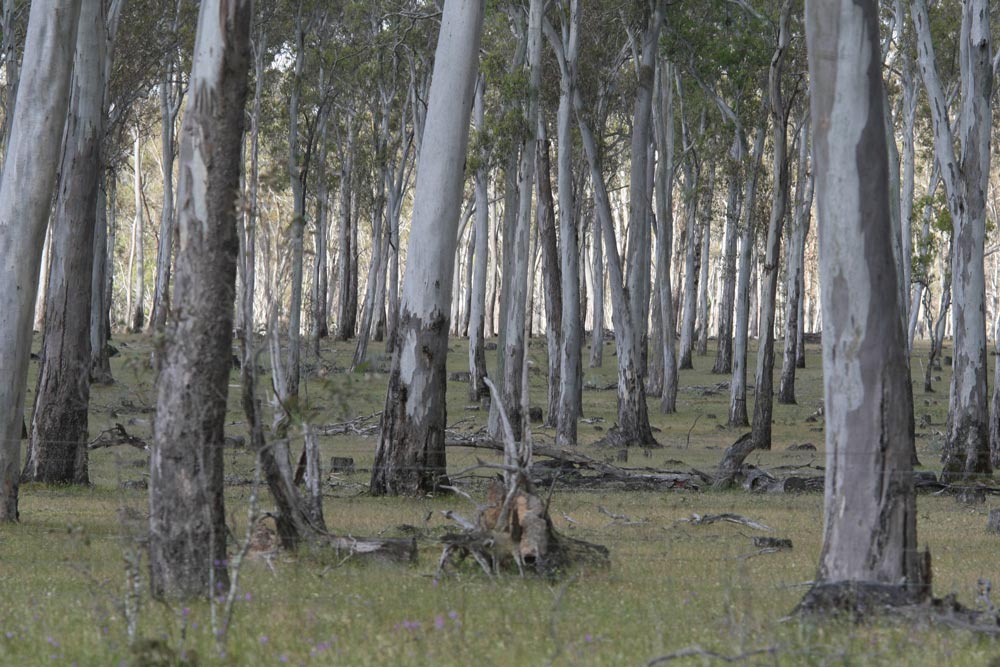 photo is copyright Gary Ayton 2007
Australian forests and woodlands:
- first a bit of knowledge about that which we intend to photograph - the more you understand, the more you see when you look because the more you know what to look for and where to look.
- the main types of forests and woodlands in Australia are:
- monsoonal northern open forests and savanna woodlands
- northern Australia from WA across NT to northern Qld
- Eucalypts and bloodwoods of the genus Corymbia
- savannas are dotted with the tall termite mounds
- tropical rainforests (eg. NE Qld)
- temperate rainforests
- cool temperate rainforests
- southern areas with high rainfall > 1200mm/yr and rare bushfires - in Australia, 95% are in Tasmania
- also found in NZ & Chile.
- dominated by southern beech / myrtle (Nothofagus cunninghamii), leatherwood (Euchryphia lucida), and in Tasmania, various pines such as Huon pine.
- blackwood swamps
- poorly drained regions such as NW Tasmania
- dominated by Blackwood (Acacia melanoxylon), tea tree (Leptospermum sp), paper bark (Melaleuca Ericifolia)
- requires occasional fires to regenerate the Blackwood
- often mixed with rainforest trees.
- wet sclerophyll rainforests
- coastal areas with high rainfall and occasional major bushfires
- characterised by very tall E. regnans and only 1 or 2 age classes of eucalypts dating the forest to last major bushfire
- dry sclerophyll forests
- drier coastal areas subject to frequent bushfires and dominated by Eucalyptus sp.
- much less dense than wet forests and have much more floristic diversity as the canopy is more open
- often different aged trees due to more frequent but less severe bushfires which leaves many trees surviving
- ash species of Eucalypt tend to favour the more fertile soils
- sclerophyl woodlands
- drier inland areas dominated by Eucalyptus sp.
- in nutrient poor soils dominated by kaolinate clays which bind phosphorus, the understorey tends to be sclerophyll such as heaths
- in more fertile soils such as from recent volcanic activity (10,000yrs ago), the understorey tends to be grasses as the cracking clay inhibits seedlings from the overstorey trees to grow.
- mallee scrub
- very dry areas in NW Victoria
- dominated by short Eucalyptus scrub
- brigalow open forest:
- areas just west of the Great Dividing Range in southern - central Qld
- dominated by Acacia harpophylla.
- mulga tall shrub
- arid regions across mid-latitudes of Australia from central coast WA through NT/SA to western NSW and SW Qld.
- dominated by Acacia aneura.
- no bushfires, no sclerophyll forests
- too frequent bushfires, no rainforest trees as they get burnt before they mature and seed
- not enough rainfall, no rainforest trees and no wet sclerophyll trees
- good rainfall with only occasional major bushfires then mixed forest of wet sclerophyll with understorey of rainforest types.
- I am mainly going to concentrate on the sclerophyll forests of Victoria.
- if you are visiting Australia, you must get to go for a walk in a wet sclerophyll forest and smell the eucalypt in the air and experience the wonderful ambience. Luckily they are close to Melbourne.
Sclerophyll forests of Victoria:
- sclerophyll forests dominate coastal and highland Australia from southern Queensland to south-western WA and Tasmania while open woodlands dominate the adjacent interior regions.
- most of Australia that can support trees is dominated by sclerophyll (“hard leaf”) communities of vegetation which perhaps evolved in Australia some 15 million years ago, but did not dominate until Aborigines arrived perhaps some 40,000 years ago and practiced regular forest and grassland burn offs which favoured the sclerophyll species over non-sclerophyll species which struggled with the combination of Australia's low phosphorus soils combined with regular nutrient loss from fires.
- the main areas in Australia where Eucalypts are absent are: the tropical rainforests of northern Qld, the highest alpine regions and the arid deserts.
- only 9 species of Eucalypts are not found in Australia - these are in Papua New Guinea, Phillipines, Timor, & Sulawesi.
- there are no species of Eucalypt native to NZ.
- the sclerophyll plants tend to have a generally inedible toxic oil (eg. eucalyptus oil, melaleuca oil) which minimises grazing losses to only certain mammals (eg. koalas) and insects which are the main herbivores in the canopies.
- indeed, the volatile nature of this oil combined with the often stringy barks and dry woods and leaves encourages fires to spread to their canopies where it stimulates their fruit (“nuts”) to open and seed on the forest floor which is newly replenished with nutrients from the ashes of the fire.
- the hot, dry summers can be dangerous times - see Bushfire safety
- a source of major annoyance to the bushwalker and camper are the many species of ants which love the forests and sclerophyll woodlands, in particular, the bull ants and jack jumper ants which can give a painful sting to which some people are allergic.
- the sclerophyll leaves are hard due to lignin which prevents wilting and allows plants to grow even when tehre is phosphorus deficiency.
- by the time of European settlers in the early 19th century, Australia was dominated by sclerophyll forests, much of which has now been cleared and the reduction of regular fires has allowed the re-colonisation of non-sclerophyll communities.
- the mix of animals depends on the type of forest and the stage of regeneration since the last major bushfire.
- Australian sclerophyll forests can be divided into two main groups:
- dry sclerophyll forests:
- the majority of forests in Australia and restricted to areas of relatively high rainfall
- generally drought tolerant and rejuvenate with bushfires
- they have a eucalyptus overstory (10 to 30 metres) with the understory also being hard-leaved.
- dominant trees include:
- grey box (E. microcarpa)
- yellow gum (E. leucoxylon)
- red ironbark (E. sideroxylon)
- messmate stringybark (eg. E. obliqua)
- their thick fibrous bark may help some survive bushfires
- also have lignotubers which enable development of mallee form after damage from bushfires
- broad leaf peppermint (E. dives) - often dominate the upper slopes of gullies rather than lower slopes where messmate may dominate
- narrow leaf peppermint (E.radiata)
- wet sclerophyll forests:
- these only occur in areas of higher rainfalls - usually > 1000mm (40“) per year
- for example, see flora of the Otway ranges
- They have a taller eucalyptus overstory than dry sclerophyll forests, 30 metres or more, and a soft-leaved, fairly open understory - often with tree ferns.
- the seasons of the forests of the Dandenong Ranges near Melbourne as documented by the local indigenous peoples includes 7 annual seasons plus a fire season every 7 yrs and a flood season every 28yrs.
- typical trees include:
- mountain ash (E. regans)
- rapidly grow to 100m, flowers in summer to winter with small white flowers
- unlike most Eucalypts, it cannot regenerate after a bushfire but does seed new growth.
- creates 2-3x as much leaf litter as other eucalypts
- these tall Eucalypts are second tallest species in the world, second to the giant Californian Redwoods, and they take some 300yrs to mature and then by 400yrs start to die - these are the “old growth forests”.
- the world's tallest flowering tree.
- in Victoria, mountain ash forests are found in the ranges east of Melbourne, the Strezelecki Range in Gippsland, the southern-most parts of the Otways and scattered regions throughout the eastern part of the Great Dividing Range.
- regeneration of the mountain ash forest after a bushfire:
- germination 1-8wks - up to 2 million seedlings germinate per hectare
- seedlings 0-4yrs
- saplings 4-15yrs - grow to 12m within 1st 10yrs but high mortality rate
- pole stage 15-30yrs
- spar stage 30-100yrs
- mature forest 100-300yrs
- old growth forest 300-400yrs
- death of mature trees 400-500yrs
- if no further major fire to germinate new growth, by 600yrs, the forest will be possibly be replaced by southern beech trees
- anywhere mountain ash exists there must have been a major bushfire to give birth to it.
- each phase characterises continual successional change in the flora and fauna habitats
- alpine ash
- found at high altitudes
- brown stringybark (E. baxteri)
- restricted to soils of low fertility
- messmate stringybark (E. obliqua)
- more frequent as soil quality improves
- usually requires > 500mm rainfall pa, and confined to SE Australia - mainly Victoria
- manna gum (E. viminalis)
- grows to 50m & oozes a sugary white gum used by Aborigines
- Southern beech or Myrtle (Nothofagus cunninghamii):
- slow growing, mountain gully tree to 30m
- Silver wattle (Acacia dealbata):
- a primary coloniser after fires, growing fast and tall but living only 30 yrs
- Blackwood (Acacia melanoxylon):
- fast growing tall tree with dense canopy to 30m in gullies
- Southern Sassafras (Atherosperma moschatum):
- slow growing, dense, conical, fire sensitive tree to 30m, grows in gullies.
- velvety cream perfumed flowers in autumn & winter
- leaves have distinct serrated edges & smell of nutmeg when crushed
- although young forests are densely packed with young trees, there is a natural thinning out process as the trees mature and the dominant trees survive at the expense of the less dominant as each compete for sunlight and water.
- the wet sclerophyll forests are mainly on the coast side of the Great Dividing Range as this region tends to have the higher rainfall.
- wet sclerophyll forests also occur on the western margins of north-east Qld tropical rainforests at altitudes above 600m where the high rainfall would normally support tropical rainforest but historic fires have kept the rainforest vegetation out. See here.
- sclerophyll woodlands:
- these are much more open habitats usually with sparse shrubs and are often much affected by human agricultural activities.
- dominant trees include:
- grey box (E. microcarpa)
- yellow box (E. meliodora)
- Blakely's red gum (E. blakelyi)
- cool temperate rainforests:
- these occur in southern regions with high rainfall and rare bushfires which allows the rainforest species to dominate while the eucalypts which rely on bushfires for seeding, to die out
- blackwood swamp forests:
- Most wet sclerophyll forests were logged and dry forest and woodland converted to pasture and cultivated land following European arrival. Over 90 percent of temperate woodlands in Victoria have been cleared, mostly for agriculture, leaving less than 6,000 km2
- Pine plantations, mostly Pinus radiata, are located in the cleared wet sclerophyll forests of this ecoregion
Photographing the forests:
- unlike deciduous Northern Hemisphere forests, the Australian forests are evergreen and although they lose their leaves during the year, it is not all at once in the Autumn or Fall and they generally do not change colour en masse as many deciduous species do, thus apart from the nice temperatures and potential for foggy weather, there is no significant colour advantage of photographing in Autumn.
- many of the tall trees flower summer-winter but it is the Spring wildflowers at ground level that are worth checking out, especially in the Grampians.
- Spring is often a good time to add colour as wild flowers tend to be at the best and the weather is not too hot or cold, and usually the bush flies are not so prevalent as in Summer. In addition, waterfalls are more likely to be flowing with some decent flows rather than a trickle as they often are in Summer.
- The weather can change quickly from a nice Spring sunny day to windy storm weather so be warned - but then alpine weather can change rapidly in any season - recently, firefighters were struggling with a month-long raging bushfire in very hot, windy conditions over 40degC which culminated after Christmas Day with a very unseasonal mid-Summer snow storm! Be prepared
- see Bushwalking.
- if you are a professional photographer or planning to publish your photos in book or on a website then you may need a licence to photograph in Victoria's parks (currently $A275 per year)
- if you are in the USA in national parks and lands under DOI jurisdiction, you may need a permit if you are professional or if you photograph a model:
- you may have mixed intentions when you photograph forests - you may be looking to create artistic, emotional works and at other times just content to document what you saw for posterity or to show others what they will see if they plan on a similar visit.
Disappointment of your first photo experiences:
- most tourists going for walks in Australia's dry sclerophyll forests in Summer will find taking great photos difficult.
- the usual lack of large flows of water in the waterfalls makes them much less than spectacular.
- the 30-100m high trees you are walking amongst are hard to show their scale without angling the camera upwards causing distortion and most likely flare, purple fringing and blown highlights from the bright sky peeking through the canopies.
- during the day, most mammal species are often hard to find as many are nocturnal.
- areas known for the Superb Lyrebird are often much frequented by tourists and sightings of the lyrebird can be difficult.
- even koalas can be hard to find if you are in the wrong forest.
- the haphazard, cluttered nature of the under-storey with its fallen rotting logs intermingled with highly reflective bracken fern leaves makes finding a typical spectacular scene of ordered English gardens very unlikely, while the usually high contrast situation of the reflectivity with sun and shade on a sunny day make for difficult, confused high contrast photos.
- ahh.. the scene just doesn't look like it is how I saw it!
- if you are lucky enough to get to the beautiful, moist wet sclerophyll forests, you often end up with another big problem - not enough light!
- unlike normal landscape photos where there are large amounts of sky, a polarising filter or gradient ND filter may not be very useful, although the polariser may have some use to control reflections on streams and it or a full ND filter may well be needed for those long exposure shots of waterfalls or streams.
- and I bet you forgot your macro lens and flash!
So what can we do to improve our photos?
- planning - a bit of thought before-hand does not go astray:
- time of day:
- can you arrange it to get there at a peak photo opportunity times such as with streaks of sunlight backlighting fog or smoke
- most of us will have to be happy with dealing with no fog or smoke and either a cloudy day (nice for reducing the high contrast normally present but risks making the sky a dull grey or burnt out white)
- bright sunny days are great for cooling off in our tall forests but make photography very difficult due to the high dynamic range, consider trying infrared on these days
- many parks do not open until well after sunrise and close well before sunset - check out their times before going.
- season:
- August - October wild flowers including the orchids in August while caterpillars feed on the grass
- after rains or during Spring for waterfalls
- check out the seasons to see what's happening with flora and fauna:
- location:
- has the forest recently be ravaged by bush fire and if so what is the extent of re-growth.
- is there immediate threat of bushfire - if so, don't go, it's not worth it.
- is the forest accessible - many roads are closed in wet weather seasons or may require 4WD vehicles to access.
- what do you wish to photograph as this will determine which equipment best suits it:
- waterfalls and streams:
- full ND filter PLUS tripod +/- polariser to allow 2 sec exposures at apertures f/8-f/11 (smaller apertures such as f/16-22 causes decreased resolution in digital cameras due to diffraction effects and shows up all your dust on your sensor).
- remember a stream lit by sunlight using ISO 100 gives exposure of 1/100th sec at f/16 so to get this to f/11 and 2secs you would need to decrease light by some 8-9 stops!!
- fortunately, most of these streams and waterfalls will not be in full sunlight so this is more feasible and by waiting until there is cloud coverage or sun goes down a bit to throw it into shade, your life maybe made easier.
- before you go, check out the orientation of any significant waterfall and decide the time of day that is most favourable in terms of the position of the sun - you usually do not want it half-lit by the sun, and if you want your 2sec exposure, no sun.
- canopy:
- don't forget to look up - some interesting photos can be had
- unless you are exposing for the sky and making a silhouette, doing these shots require high quality lenses with lens hoods to reduce lens flare and purple fringing around junctions of bright sky and leaf edges - time to take your filters off the lens as these tend to introduce more flare - but watch out for falling sap from trees - does not come off lenses very well.
- a relatively wide to normal focal length may be most suitable, although a short telephoto may be needed depending on the height of the canopy and the patterns of interest.
- trees:
- the trees are what make the forest and they often have beautiful trunks with dangling bark, but they pose a big problem - they tend to be very tall 20-30m and higher and you tend to be relatively close, so you either need to stand back a bit and / or use a ultra wide angle lens.
- Remember to keep the lens parallel to the ground if you want to minimise converging lines but this requires use of a ultra-wide lens (the Olympus ZD 7-14mm which gives a 14mm effective focal length is great for this) or you need a shift lens such as the Canon 24mm TSE lens on a full frame EOS body.
- Of course, you may well find you have to tilt your camera upwards and you can either accept the converging trees or try to correct them in Photoshop.
- trees are usually best photographed in fog/smoke in overcast conditions or with light streaking in at 45deg angle from the sky and side or backlighting the fog. Ahhh… we can only hope.
- macro work:
- this is where a lot of the fun can begin in forests as there is always goodies to photograph no matter what the light conditions are - bring a torch if you have to to allow you to focus better.
- there are a multitude of insects, small plants, leaf patterns, wild flowers and perhaps most fascinating of all, the many diverse species of often colorful fungi.
- if you plan on this, then you ideally need a macro lens and if possible a TTL-dedicated ring flash &/or a flash that can be used off the camera to provide side lighting or back-lighting.
- you could just use your on-camera flash but these often cast a shadow caused by the lens when used for macro work, and also tend to be too powerful for such close up work (hint… try reducing its output by placing white paper or cloth or tissues in front of it).
- you may be able to do some available light shots, especially if your camera can do high ISO with minimal noise, but generally the light levels on the forest floor are low and many fungi live in the shade.
- see macrophotography.
- birds and other wildlife:
- unless you are in the tropics of Australia, all creatures in the forests are quite small and you will need to be quiet to get to see them and need a decent telephoto (300-600mm in focal length with image stabiliser) to photograph them well
- try the Olympus Four Thirds dSLR system with the very affordable and powerful ZD 70-300mm ED lens or the more expensive ZD 50-200mm f/2.8-3.5 SWD lens, or if you are really a fanatic, the ZD 150mm f/2.0 with EC-20 2x teleconverter to give a hand-holdable 600mm f/4 effective lens or even the ZD 90-250mm f/2.8 lens to give an incredible 180-500mm f/2.8 zoom but at a cost and with more weight and need for a monopod, but perhaps the best birding combination.
- if you are lucky, you can get a bird backlit by the sun without the sun hitting your lens and causing flare - don't forget to expose for the bird - you may need your spot metering mode activated.
- if you are extremely lucky you may see the Superb Lyrebird in full display but for this your best chances are in April through to August when the males perform their courtship displays.
- koalas begin to mate in August and the males bellow at night.
so which equipment would I take?
- our needs become:
- relatively light, compact system as we need to carry it some distance in a backpack
- weatherproof as some of the best photos will be during rain or fog, and in case it really pours rain and our backpack becomes compromised, then a weatherproof camera & lens system may save us losing everything.
- relatively robust - backpacking can be stressful on your cameras and lenses.
- reasonable high ISO performance and reasonable burst rates for the bird shots
- a range of lenses:
- ultrawide eg. 14mm in 35mm terms
- wide angle lens (eg. 21-28mm) for infrared work with aperture f/2.8 or wider for Live Preview and tested to ensure no central hot spots
- standard zoom lens
- relatively long macro lens with wide aperture for low light focusing eg. 100-200mm f/2.0-f/2.8 in 35mm terms
- super telephoto for birds with image stabiliser
- macro flash capability:
- TTL-dedicated ring flash
- off-camera wireless TTL flash
- good, light tripod which will be needed for:
- long exposure water scenes
- long exposures for infrared photos if using an unmodified dSLR
- bracketed exposures for high dynamic range work, particularly on difficult, sunny days
- available light macro shots in poorly lit undergrowth where the fungi grow
- super telephoto shots of the small creatures - you won't find too many elephants in the Australian bush
- ND filter, polariser filter for the waterfall & stream shots
- R72 infrared filter if you plan digital infrared shots
- in my mind the best systems that suits all of these is the following:
- smallest but very good image quality weatherproof, versatile hiking kit:
- Olympus m.ZD 12-50mm f/3.5-6.3 EZ MSC weatherproof zoom lens - weatherproof, compact, light, 24-100mm focal length range, silent for video, fast AF, plus nice macro capability
- consider Olympus m.ZD 12mm f/2.0 lens for hand held 1/3rd sec waterfalls or infrared (with 10 stop and R72 filters)
- on a budget (not weatherproof but very capable, light systems with IS) :
- Olympus kit:
- Olympus Four Thirds dSLR system with kit lens
- Olympus ZD 50mm f/2.0 macro +/- ring flash
- Olympus ZD 70-300mm ED lens to give 140-600mm reach
- has the better upgrade path compared with the Canon, just add high quality lenses then when you have the money, get the E3 or its successor in 2009/2010.
- Canon kit with EF-S lenses:
- Canon 7D with IS kit lens
- Canon EF-S 60mm f/2.8 Macro USM but no IS
- probably have to go for an expensive EF 70-200mm f/2.8L IS although it's not optimised for this camera, but what other choice is reasonable that gives IS on an EF-S telephoto lens?
- the problem with this kit is the lens choices and lack of IS in the body.
- those with a pro budget:
- weatherproof pro Olympus kit:
- Olympus ZD 7-14mm
- Olympus ZD 12-60mm “kit lens”
- Olympus ZD 50mm f/2.0 macro + Olympus ring flash and adapter
- Olympus ZD 50-200mm f/2.8-3.5 SWD lens
- this kit will photograph practically anything for you - no excuses!
- you can even do nice IR shots without modification just add an R72 filter.
- if you need more macro or more telephoto, just add the excellent EC-20 2x teleconverter.
- kits based on either Nikon D300, Nikon D3, Canon 5D, Canon 1DsMIII but these will be MUCH heavier, bigger and not as weatherproof or have the low light AF functionality as the Olympus E3 kit.
- a final warning on equipment:
- not only does heavy equipment end up staying in the car, it ends up getting stolen from your car while you are gone!
Some links to nice forest photos (not mine unfortunately and not Australian):
- http://photo.net/photodb/photo?photo_id=6542687 - morning fog in Autumn
- http://photo.net/photodb/photo?photo_id=6531756&size=lg - morning fog in Autumn
- http://photo.net/photodb/photo?photo_id=6639445 - nice waterfall in the Fall.
- http://photo.net/photodb/photo?photo_id=2896557 - nice if you can get a subject like this & have lighting just right
- http://photo.net/photodb/photo?photo_id=3035373 - sometimes you find a nice stream and you have a tripod with you.
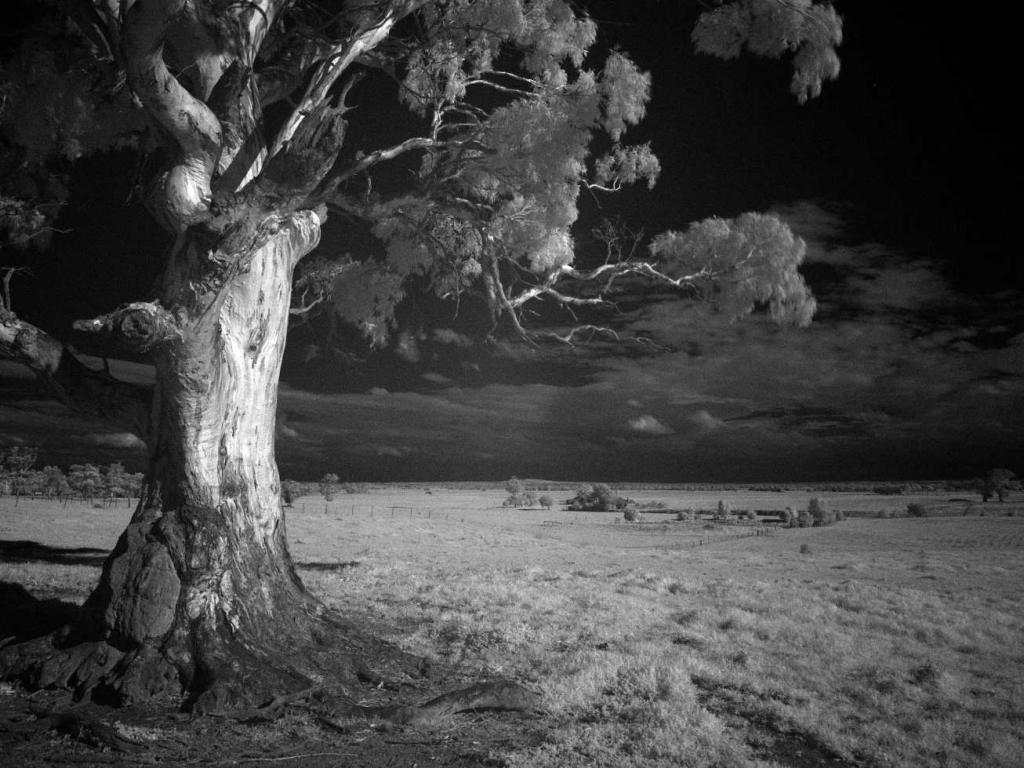 one of my digital infrared photos - Eucalypt woodland near Melbourne