
australia:vic:otways_weather_events
Table of Contents
Otway Ranges major weather events and floods
Introduction
- the highest major risks in the Otways are the frequent bushfires, mainly due to dry lightning strikes in Summer
- nevertheless, the Otways are particularly exposed to incoming storms and weather systems from the Bass Strait, but the coastal areas around Lorne tend to be more impacted by Low pressure systems to the east bringing moist SE winds and potential for prolonged heavy rainfalls
- Weeaproinah is on a ridge line in the western part of the Otways and is renown for being the wettest region of Victoria
- the Otway Ranges create a rain shadow effect for the area to its north-east in particular, including the western suburbs of Melbourne (which also are in a rain shadow from the NW courtesy of the Macedon Ranges)
- uncommonly, sleet or snow may fall in the Otways, mainly in June-August when very cold air from the Antarctic is brought up by cold fronts which can cause snow falls down to 500m elevation
- Falls Music Festival, near Lorne - more known for its heat waves over the New Year period - was turned into a “winter wonderland” 24th June 2016
- damaging tornadoes and water spouts are rare events
- in 2015, a mini-tornado caused damage to a Bunnings store roof in Torquay
- major rainfall events significantly increase the risk of landslides on the Great Ocean Road as well as flooding, road damage and hence unexpected and potentially prolonged road closures
- these events also increase the risk that the coastal cliffs overlooking beaches become unstable and may have sudden rock falls or land slips and so beach goers should keep their distance from cliff faces - particularly during or after subsequent rain events
- the coastal hills can create unexpected changes to wind directions as they may channel winds around them - this is particularly evident at Jamieson Creek camp ground Wye River
Geographic aspects that may affect flash flooding
- catchments along the Great Ocean Road are small and steep with narrow floodplains making them susceptible to flash flooding from heavy rainfall events
- areas in the Otways are particularity at risk due to the very few road access options which are readily blocked by flooding or landslides
- the Otway Ranges have a 500m elevation ridge line running essentially parallel to the coast line from Glenaire in the SW to Mt Sabine and then a less defined ridge to Mt Cowley near Lorne
- as the prevailing moist winds are mainly from the SW, S or SE, this means the area between the ridge line and the coast has much higher rainfalls and more lush rainforest growth than the slopes on the leeward side which due to orographic lift of the winds generally has drier warmer air with less rainfall.
- orographic effects of 670m elevation Mt Cowley near Lorne
- this is the tallest mountain in the Otway Ranges
- the Erskine River the the region to the north and north-east of Mt Cowley
- Cora Lynn creek drains the north-east side of Mt Cowley then into St George River
- St George River drains the north-east side of Mt Cowley then into Allenvale Dam then to Phantom Falls
- it directly drains the NE slope of Mt Cowley via Fisher Creek
- Henderson Creek (and Henderson Falls) drain the south east side of Mt Cowley then drain into St George River at Allenvale
- the Sheoak creeks (and Kalimna Falls) directly drain the east and south east side of Mt Cowley
- the Garvey Creek which drains into the Cumberland River drains the south side of Mt Cowley,
- headwaters of Garvey Creek are at 600m elevation and drains the south and SE slopes of Mt Cowley
- headwaters of Cumberland River itself is at 600m elevation and east of the Benwerrin-Mt Sabine Rd ridge
- Jamieson Creek drains the south side of Cumberland Track ridge line 4.5km south of Mt Cowley, headwaters are at 450m elevation
- the headwaters of the Wye River lie 8km SW of Mt Cowley
- orographic effects of 587m elevation Mt Sabine near Tanbryn
- Kennett River drains the region to the north and north east
- Grey River drains the eastern aspects
- Carisbrook Creek drains the south-eastern aspects
- Sugarloaf Creek drains the southern aspects
- Smythe Creek starts in a steep valley to the SW
- Skenes Creek drains the west side of the Skenes Creek Rd ridge line
- Wild Dog Creek drains the slopes south of Turtons Track (elevation c500m)
- Beech Forrest - Weeaproinah ridge at 500m elevation
- Aire River drains the southern slopes
- Gellibrand River (Stevensons Falls) drains the northern slopes
- Barham River drains the Paradise Valley region west of Apollo Bay and headwaters drain elevations 400-500m
Flooding events
- a flash flooding event of caravan park occurring at night would present much greater risks to life
- caravan parks and camping grounds are commonplace along Australian rivers and streams and are at risk of flash flooding events
- large populations of tourists unfamiliar with local hazards and emergency arrangements are particularly vulnerable and caravans and tents can easily be washed away
- flash flood warnings can be associated with high degrees of uncertainty as they are more difficult to predict than slower rising riverine floods
- take great care on beaches after such flooding - and if possible avoid them:
- there is a lot of debris, including sharp objects
- there are likely to be at least a few live snakes washed down the rivers onto the beaches and amongst the mud
- the sea water is likely to be severely contaminated with pollutants, sewage, etc and not fit for swimming in
- avoid being near cliffs as the risk rock falls or land slips after heavy rains
Jan 15th 2026 record flash flood event
- highest rainfall in a day for the Otways in 75yrs bringing a record 177mm rain over 3-6 hours for that station (including 115mm in 1 hour, previous 24hr record record for that station was 123mm) onto 700m elevation Mt Cowley resulting in extreme flash flooding to Erskine, Cumberland and Wye Rivers, flooding camp grounds, which surprised campers and caravan park staff on the coast which only had a fifth to a third of this rainfall, resulting in many cars and at least one large caravan floating out to sea
- the heaviest rainfalls were on the windward (coastal) slopes of the ridge from Mt Sabine to north-east of Mt Cowley, particularly affecting all the coastal side creek and river catchments from Wye River up to Erskine River with much less rainfall on the actual coastal towns
- this was due to a Low pressure system just NE of Melbourne (it felt very muggy in Melbourne that morning) and an associated upper level trough from the north bringing relatively warm, very moist air from east Australia, across Bass Strait and as a strong south easterly hitting the coast line mainly near Lorne and then being orographically uplifted by Mt Cowley to form a relatively stationary thunderstorm
- the weather conditions that helped them form can be traced back to ex-Cyclone Koji, which brought very humid conditions into Australia and had caused flooding in some parts of outback Queensland
- this meant that any storms that did develop through convection or developing clouds were able to tap into all that moisture … and bring very heavy rainfall, while the upper-level trough helped intensify the stormy conditions
- the State Control Centre said 10,000 people in areas along the Great Ocean Road received emergency texts alerting them to the flooding however, those in caravan parks have said they only received txts an hour after their caravan park had flooded and some in Lorne said they received it 15 minutes before the flooding went over the Great Ocean Road in Lorne
- the first Triple Zero (000) call was made at 1:08pm for flooding at a caravan park, and another call about cars being washed away followed at 1:20pm
- the BOM issued a severe storm warning for the risk of heavy rain and flash flooding at 11:47am, this was escalated to a warning for potentially intense rainfall and life-threatening flash flooding at 12:40pm. At 12:58pm, VicEmergency declared a Watch and Act warning, urging people in the Otways and inland from Lorne to take shelter due to the thunderstorm. An hour later, another Watch and Act was issued for numerous communities along the coast, including Lorne, Separation Creek, Skenes Creek and Wye River. This was upgraded to an Emergency warning at 2:36pm, with emergency broadcasters asked to break into programming with the Standard Emergency Warning Signal used for cyclone and bushfire emergency messages
- about 200-400 locals and holiday-makers were displaced from low-lying areas, including caravan parks, fortunately, no-one drowned in the floodwaters or their flooded vehicles
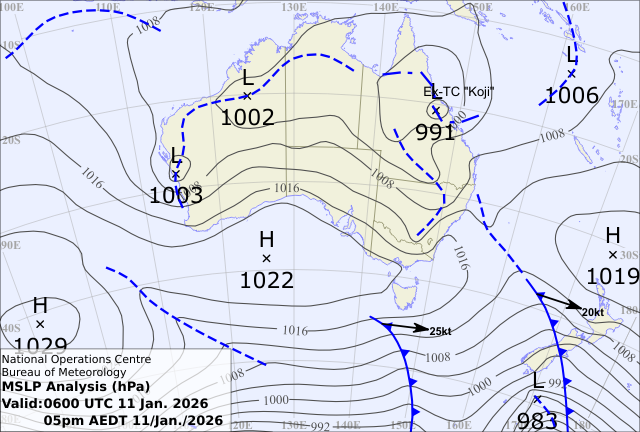
Weather map on Sun 11th Jan showing ex-cyclone Koji heading inland with the upper level trough extending south to Victoria
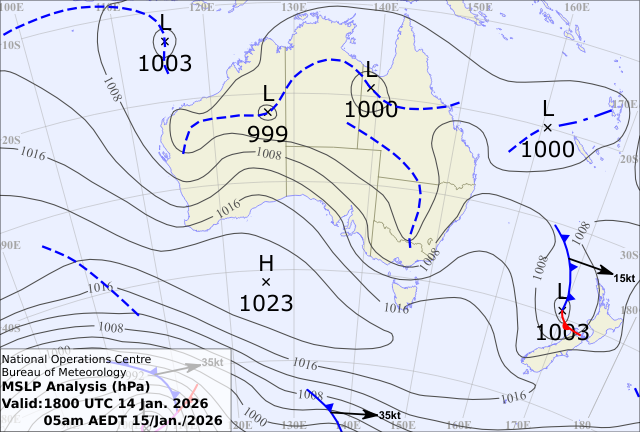
Weather map on the prior day Wed 14th Jan showing the strengthening upper level trough and the Low just about to form in Victoria at its southern end and warm moist air also being injected from across the Tasman Sea
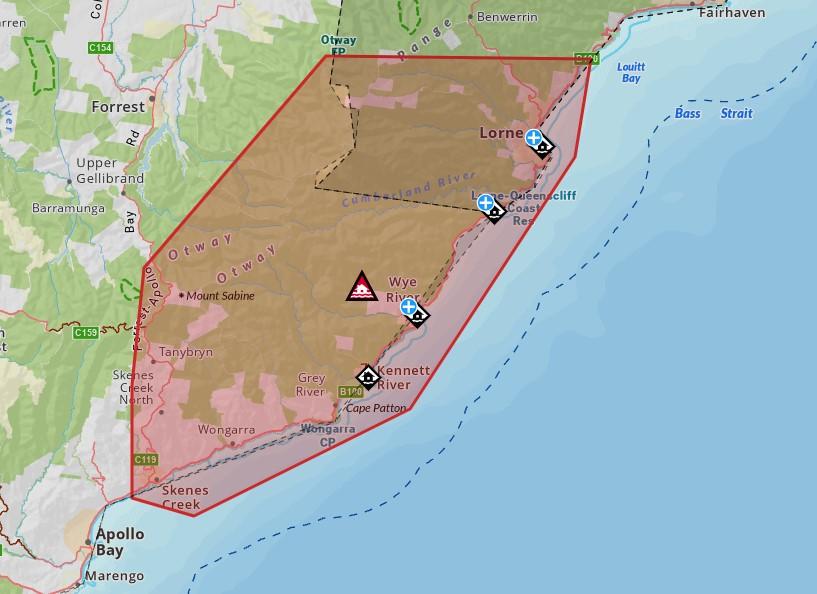
Weather warning issued that day?
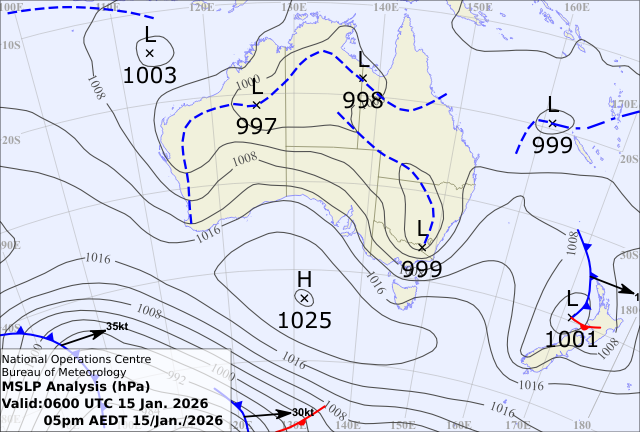
Weather map 6am before the deluge started
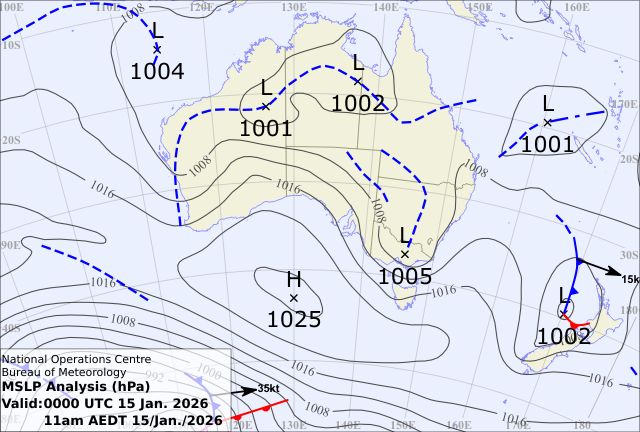
Weather map 11am during the deluge
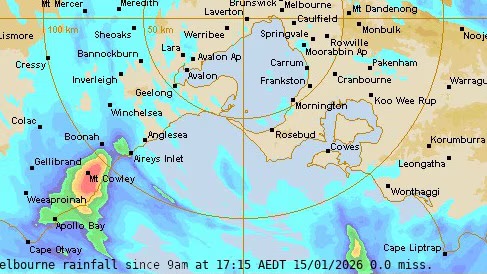
Rainfall distribution
Oct 2022
- Victoria endured statewide floods that killed four people, destroyed 1,700 homes and damaged thousands more — including repeat inundations along the Great Ocean Road and the Otways rivers.
Jan 2022
- Jan 28: 100mm rainfall event causing flash flooding in Anglesea and Aireys Inlet
- Anglesea age care facility flooded, requiring evacuation of residents.
Oct 2016 flash flooding of Otways and western Victoria
- within the Shire, 80 properties and 52 hectares affected, infrastructure damage
27th Jan 2016 event
- a “1 in 100 yr rain storm” delivers 40-70mm rain in 1hr causing flash flooding in Geelong, Vic
Nov 2007 event
- Cumberland River Caravan Park evacuated due to flash flooding.
Nov 1995 flood
- Severe rainfalls in the Otways produced extensive flooding in the Barwon River with substantial stock losses, local erosion and one house flooded.
- Flooding in the Thompson Creek catchment also caused widespread disruption.
April 2nd 1985 Wye river flash flood
- 40 caravans were washed into the sea at Wye River. Luckily most vans were empty at the time. The river had been said to have risen more than a metre in 30 minutes.
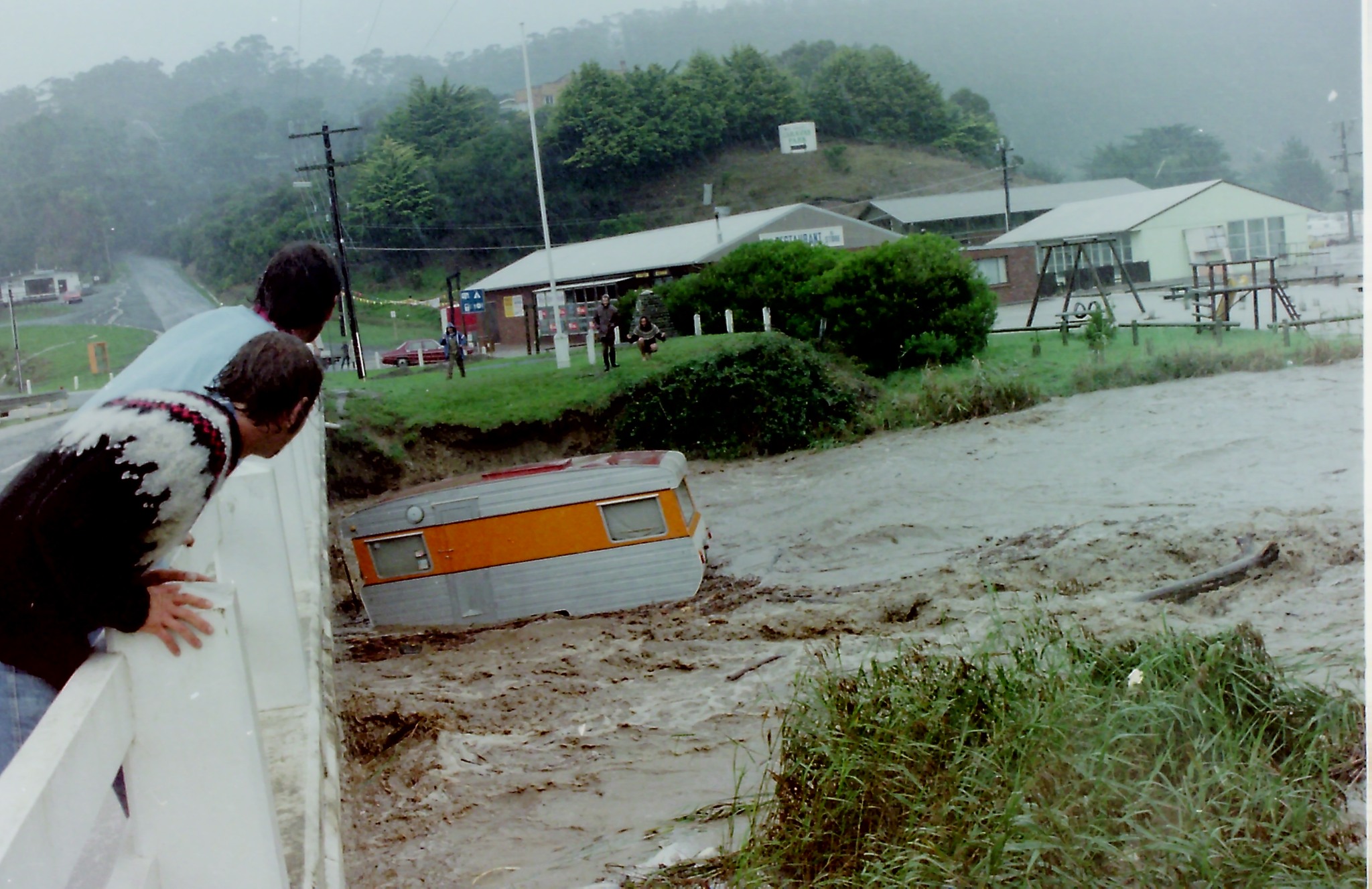
1983 Cumberland River flood
- after the Ash Wednesday bushfires?
1951-52 floods
- During the 1952 flood, a near emergency occurred when an Army Duck with a sick elderly lady and a pregnant woman on board was jammed against a bridge on the Birregurra – Deans Marsh Road just out of Birregurra
- floods during 1951 and 1952 caused substantial loss to private property as well as damage to bridges within the Shire.
Oct 1882 Barwon River flood
- lives were lost by drowning while rescuing sheep at Ripple Vale.
australia/vic/otways_weather_events.txt · Last modified: 2026/01/22 22:00 by gary1